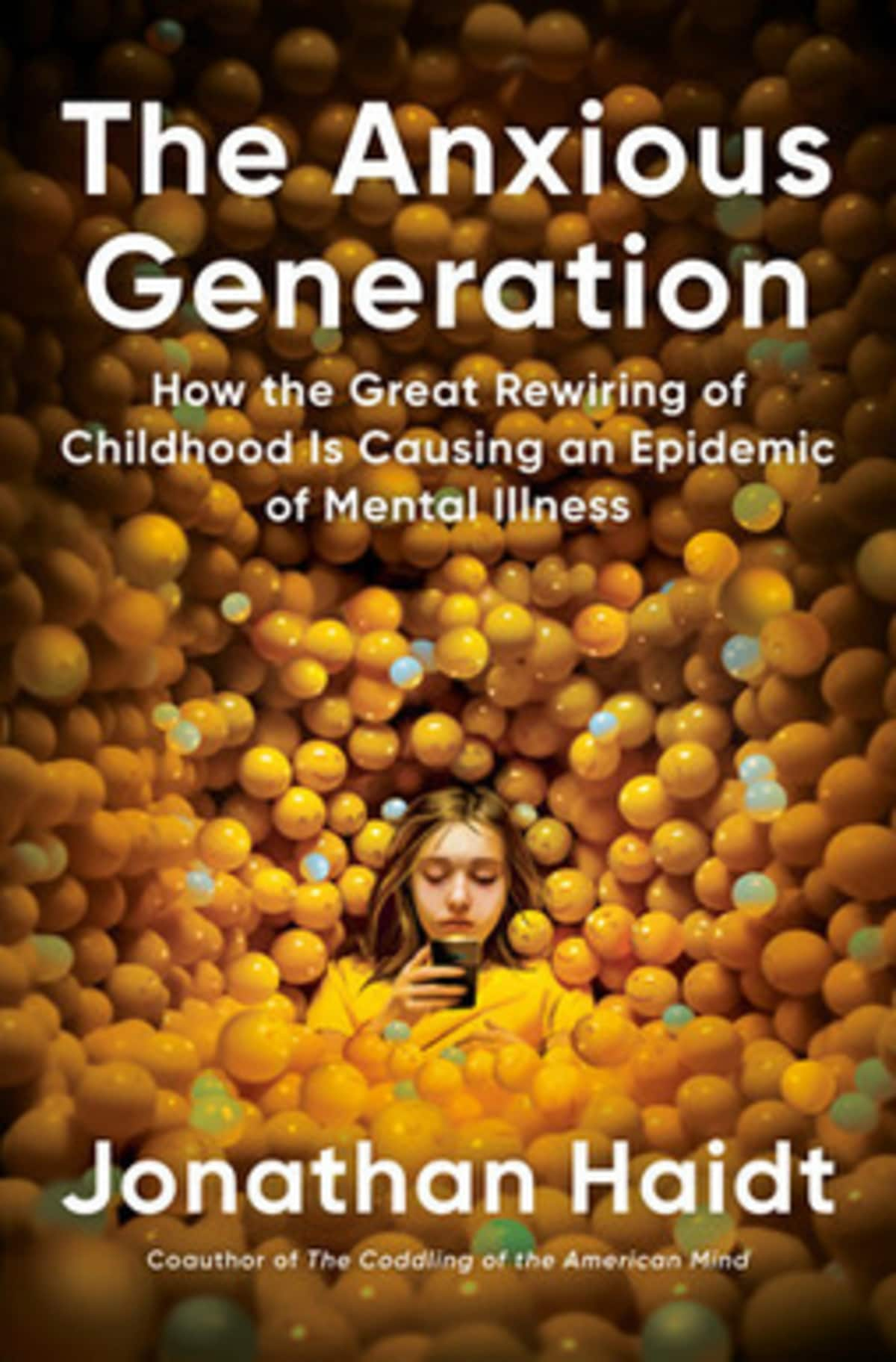
After listening to the really interesting interview Trevor Noah did with the author of The Anxious Generation, I did a bit of research to get the critical side of the argument that social media and screen time are harming young people. It wasn’t just my old journalist instincts kicking in. It’s because Jonathan Haidt’s arguments made a ton of sense for me, a mom with two teenage daughters. I’ve also had to reassess my social media usage for the sake of my own mental health. So I wanted to know if Haidt was just preaching to the choir, and if so, why his arguments resonated so much with me and millions of others. His book has been a NYT bestseller for a year or so.
In a nutshell, Haidt talks about two related things; the decline of free outdoor play and the rise in tech designed to keep kids indoors and dependent on that dopamine hit from social media and certain kinds of gaming. This has led to increasing rates of anxiety and depression, concentration problems, feelings of isolation or worthlessness, and an inability to tolerate what is uncertain, unknown, potentially risky, or different than what kids are used to. Haidt’s most scary argument was that kids are so dependent on adults monitoring every bit of their childhoods in real life, the US is raising a generation of kids dependent on authority figures. We all know where that leads.
Critics of his book have argued there’s no real science to back up the argument that the tech is responsible for some of these changes in kids. The 2000s has been a challenging century already, to put it mildly, and kids have to cope with a lot of new and scary situations just like adults do, but without our experience, maturity and (hopefully) wisdom. It’s incredibly hard to point to one factor – like smart phones or social media — and say that’s the smoking gun. Between wars, climate change, global recession, a pandemic, school shootings and the decline of democracies, there’s a lot to deal with. No wonder kids (and adults) are more anxious.
I get all that, but here’s the thing. I’m American, but I don’t live in the US. I’ve raised my kids in Europe, and there are now definite, quite large differences between how kids are raised here vs there. My kids played outside every day (until the pandemic stupidly forbade them from using playgrounds). First graders (age 6-7) go to school on their own, either walking, biking or taking the city bus. It’s common for kids to run an errand for the family, to the store or a bakery, or to get ice cream, or otherwise be out and about without adults around. My kids used to go play in the local forest, and my 15-year-old loves hiking there, even alone. Americans tell me this is possible because Germany is safer, which statistically, it is. But a lot of this has to do with how safe the parents feel and how stable their communities are.
Kids here are also very attached to their phones, moreso than they should be. A new study said about a quarter of German teens use social media at addictive levels, with anxiety, depression and hyperactivity not far behind. After the pandemic, schools made the questionable decision to give school tablets to all students from grade 7 on up. Kids spend a whole lot of time goofing off on those instead of listening in class. Ironically, this switch to screens in school has driven my Gen Alpha daughter away from screens in her free time. She limits her own screen time, has lots of analog hobbies, and neither of my teens care about social media at all. They have phones, they text friends, they look stuff up, play games, watch YouTube vids. But no Insta, no FB, no TikTok(!) and zero interest in them. I was the one in our house who used social media too much — and they probably saw what it did to me.
As a new author, I was encouraged to connect with readers and other authors on social media, and for a while, this was a great thing. For a while, I could ignore the toxic aspects of social media to find people who’ve become my friends, sometimes even in real life. I’ve learned a lot from readers, from listening to people in the publishing industry, from sharing the publishing journey with my peers. But. . .with time, it became a problem. I grew more anxious, more obsessive about checking my channels. I doomscrolled. A lot. My moods swung with whatever I happened to see in my feeds. The increasing amount of negativity, bullying and attacks made social media feel more like a hostile environment than the half-way friendly one I used to know. I found myself spending so much time curating my feeds, blocking people, trying to figure out how to get *my* stuff seen by the right people, it became too much. What was the point? I couldn’t see the value anymore. I was losing the joy in being an author.
So I stopped. Almost cold turkey. The first week, I kept reaching for my phone before I remembered I’d deleted the apps. After that week, I was free. That was about a year ago. I don’t use my channels much anymore. I don’t miss them. I’ve been finding other ways to connect with the people I want to connect with. At home, I’m more present, more stable, and more interested in things and people in my real life – which is where life actually happens.
This one change — cutting out most social media — has done wonders for me. I can concentrate better. I’m not as anxious. My moods don’t swing nearly as much. I actually have time for hobbies! I still use my phone a lot; it’s where my music, audiobooks and my many, many podcasts are. So this was not about using my phone less, it was about what I used it for. It’s safe to say clearly something in social media specifically was bad for me. I now know to use it with great caution and very strict limits. A bit like alcohol.
Now we’re back to The Anxious Generation. When I hear a researcher say that certain kinds of screen time – for girls in particular, social media — is harmful, that rings a huge bell because it harmed me, and I’m an adult. I played outside as a kid, I was a latchkey kid, I had to do a lot on my own because my parents worked. I watched a lot of TV and at one point I think we had an Atari (!), but no smartphones, of course. I had the largely free, unmonitored childhood Haidt talks about. Unlike kids, I have a fully formed brain, and I was still damaged by social media use. It makes perfect sense that the tech *is* doing something to some if not many kids. It did something to me.
Limiting usage has helped me immensely. Australia has led the countries considering a minimum age for social media access, and I’m definitely inclined to agree with that. Sixteen might be an okay age for kids to start. At sixteen, you can drink beer and wine in Germany. Oops, here I go again, comparing social media to alcohol. .